Motion Control Solutions for Intelligent Robotics Equipment

Multi-Axis Flexible Precision Trajectory Control, Tiered Solutions for Intelligent Robotics Equipment

Intelligent Robotics Equipment

Industry technical challenges

Large dynamic load fluctuations in robotic arm joints

Stepper motors have fixed torque-speed characteristics; sudden load changes directly cause step loss. All multi-joint robotic arms and high-speed sorting robots require servo closed-loop torque drive; steppers cannot meet dynamic load self-adaptation requirements.

AGV travel positioning errors

Open-loop steppers lack odometry feedback; floor slippage and load fluctuations create cumulative errors. As analyzed in the logistics and warehousing section, steppers are prohibited for AGV travel drive.

Multi-axis trajectory interpolation is executed by the controller

Robots require complex arcs, interpolation, and continuous trajectory motions. Interpolation algorithms are executed by the motion controller, independent of motor type. Servos only precisely execute trajectory commands issued by the controller.

Precision decay in long-term cyclic operation

Intelligent robots typically operate in 24/7 high-frequency cycles. Thermal drift and mechanical wear introduce minor precision deviation; no system maintains permanent zero-drift performance.

Working Condition

Stepper Motor System Applications

Extremely limited scope: Only desktop fixed‑point simple transfer platforms and static low‑speed material pushers.
Strict conditions:
No multi‑joint robotic arms: No joint (including wrist) may use steppers – dynamic load changes cause step loss and trajectory deviation.
No high‑speed sorting: Cycle rate insufficient (stepper 120/min);
No AGV travel: No odometry feedback, cannot achieve closed‑loop positioning;
Only ultra‑low‑cost auxiliary platforms with constant load and single fixed trajectory – no dynamic load adaptation capability.

Servo Motor System Applications

Suited for multi‑joint industrial robotic arms, collaborative robots, high‑speed sorting robots, AGV travel drives, and heavy palletising robots in intelligent robotics; real‑time closed‑loop torque with dynamic load adaptation (response <5 ms), combined with controller high‑precision interpolation for smooth complex trajectories.
Servo selection guidelines by category:
High‑voltage servo (220V/380V): Standard industrial arms, heavy palletising, high‑speed sorting;
Low‑voltage servo (24V/48V): Collaborative robots, mobile manipulators, AGV travel;
Integrated servo: Light collaborative robot joints, end‑effectors, space‑constrained applications;
Servo with brake: All robotic arm joints (drop prevention on power loss) and vertical axes.

Tiered Technical Solutions

Industry characteristics & selection logic:

Intelligent robots feature multi‑axis coordination (4–7 axes), dynamic loads (gripped weight variation 0–10 kg), complex trajectories (linear/arc/spline interpolation), high cycle rates (>120/min), and repeatability (±0.02–0.05 mm). All joint drives must use servos; steppers limited to peripheral fixed single‑axis platforms (not robot body). Selection must consider load weight, inertia matching (load inertia / motor inertia ≤10), brake safety (standard on all joints), communication latency (<1 μs), installation space, and IP rating.

Solution 1: Basic fixed platform – Open‑loop stepper single‑axis simple transfer (peripheral only)

• Matched products 57J1856‑440 (1.2 N·m) or 86J1880‑460 (4.5 N·m) + 2DM556 (1.4–5.6 A, DC 24–60 V) or 2DM860 (2.1–8.4 A, DC 24–110 V) • Applicable equipment Desktop fixed‑point simple transfer platforms (single‑axis, fixed trajectory, load ≤10 kg), static low‑speed material pushers (no robotic arm, no AGV, no dynamic load) • Technical features Smooth at medium‑low fixed trajectory (≤300 rpm); resonance points need vibration suppression; Strict restrictions: No multi‑joint robotic arms – no joint may use steppers; dynamic load changes cause step loss and trajectory deviation; No high‑speed sorting – cycle rate insufficient (stepper <60/min, sorting >120/min); No AGV travel – no odometry, cannot closed‑loop position; Only for ultra‑low‑cost auxiliary platforms with constant load (fluctuation <10%) and single fixed trajectory – no dynamic load adaptation; IP54 optional. • Selection boundary Only for peripheral robot loading/unloading platforms, not any robot body axis; beyond this, upgrade to Solution 3/4/5/6 (servo).
Intelligent Robotics Equipment-solution-1

Solution 2 : Peripheral horizontal transfer – Closed‑loop stepper single‑axis fixed‑point transfer (peripheral only)

• Matched products 86J1880EC‑1000‑LS (4.5 N·m) or 86J18118EC‑1000‑LS (8.5 N·m, 1000 P/R) + 2HSS86H (0–6 A, DC 30–100 V) • Applicable equipment Fixed‑point low‑speed transfer platforms (single‑axis, constant load ≤30 kg, no joint structure), robot loading/unloading auxiliary positioning tables • Technical features Closed‑loop compensation for fixed‑trajectory low‑speed step loss, repeatability ±0.02 mm; Lacks torque response and adaptation for dynamic variable loads – strictly prohibited for multi‑joint arms and dynamic sorting; Only for peripheral robot auxiliary stations, not robot body; IP54 optional. • Selection boundary Same as Solution 1 – peripheral horizontal transfer only; any robot body joint upgrade to Solution 3/4.
Intelligent Robotics Equipment-solution-2

Solution 3: Industrial robotic arm core drive – High‑voltage servo with brake for multi‑joint control

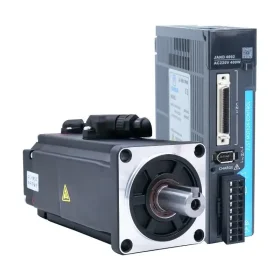
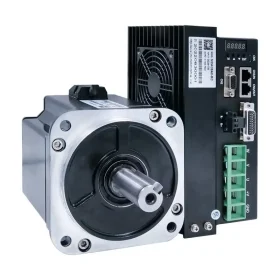
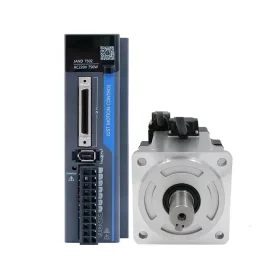
• Matched products (per‑joint grading) Wrist/forearm (load ≤2 kg, low inertia): 60JASM504230K (400 W, rated 1.27 N·m, peak 3.82 N·m, rotor inertia 0.5×10⁻⁴ kg·m²) + brake Upper arm/shoulder (load 5–10 kg): 80JASM507230K (750 W, rated 2.39 N·m, peak 7.1 N·m, rotor inertia 1.5×10⁻⁴ kg·m²) + brake Base/heavy joint (load >10 kg): 130JASM515220K (1500 W, rated 7.2 N·m, peak 24.6 N·m, 17‑bit) or 130JASM520220K (2000 W, 9.55 N·m) + brake Drives: JAND‑series EtherCAT drives + JMC‑101‑32 (32‑axis EtherCAT controller) • Applicable equipment Multi‑joint industrial arms (4–7 axes all servo), human‑robot collaborative robots (all joints), heavy fully automatic palletising robots (base/upper arm/forearm/wrist) • Technical features Precisely executes controller‑generated multi‑axis interpolation (linear, arc, spline) with smooth, jerk‑free cornering; Torque closed‑loop real‑time adaptation to grasped load variation (response <5 ms) ensures stable placement for different workpiece weights (repeatability ±0.02 mm); Each joint comes standard with brake motor (holding torque ≥1.5× rated) for immediate hold on power loss to prevent arm drop; Bus communication jitter <1 μs for precise multi‑axis coordination; Long‑term high‑frequency cycling produces only minor mechanical/thermal drift (<0.02 mm/24 h); regular calibration recommended (weekly) to maintain repeatability; IP54/IP65 optional (welding/dust environments). • Selection boundary All joints of industrial arms, collaborative robots, and palletising robots must use this solution (per‑load grading); stepper solutions strictly prohibited.
Intelligent Robotics Equipment-solution-3

Solution 4: Collaborative robot compact drive – Low‑voltage servo + integrated design

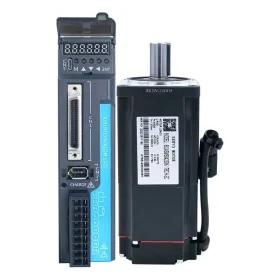
• Matched products Discrete (flexible layout): 60ASM400‑5‑17BCH (48 V, 400 W, rated 1.27 N·m, 17‑bit) + MCAC610‑23B‑EC (low‑voltage bus drive) Integrated (ultra‑compact): IESV60‑30‑40‑48‑17BC‑EC (48 V, 400 W, 1.27 N·m, 17‑bit, EtherCAT, mounting length ≤72 mm) • Applicable equipment Collaborative robot joints (light load ≤5 kg), flexible assembly robots, medical assistance robots, human‑robot interaction arms • Technical features Low‑voltage supply (24–48 V) meets SELV safety for human‑robot collaboration; Low inertia design (rotor inertia 0.5–0.7×10⁻⁴ kg·m²) for frequent start/stop and reversal (accel/decel <15 ms); 17‑bit encoder ensures high‑precision joint positioning (repeatability ±0.02 mm); Integrated version fully combines drive and communication, minimising volume – ideal for joint‑internal mounting (axial length shortened ~35 mm); Bus control for multi‑joint coordination (jitter <1 μs), supports force/torque modes for collaborative compliance; Noise ≤40 dB, IP54 optional. • Selection boundary Suitable for light collaborative robot joints (load ≤5 kg); for load >5 kg or higher torque, upgrade to Solution 3 (high‑voltage servo).
Intelligent Robotics Equipment-solution-4

Solution 5: High‑speed sorting robot – Ultra‑low inertia servo for high‑speed dynamic response

• Matched products 60JASM504230K (400 W, rated 1.27 N·m, peak 3.82 N·m, rotor inertia 0.5×10⁻⁴ kg·m²) + JAND4002‑23B‑EC (EtherCAT drive, 2.8 A) • Applicable equipment High‑speed parallel robots (Delta, 3–4 axes), SCARA robots (3–4 axes), high‑speed sorting manipulators (cycle >150/min) • Technical features Ultra‑low rotor inertia (0.5×10⁻⁴ kg·m²) for extreme accel/decel (<10 ms,acceleration >5 G); 17‑bit encoder ensures high‑speed trajectory tracking accuracy (repeatability ±0.02 mm); Bus sync jitter <1 μs, no delay in multi‑axis coordination; Dynamic torque adaptation for varying pick weights (0–2 kg); Cycle rate up to 150–200/min for high‑speed sorting; Selection constraint: For load >2 kg or higher torque, upgrade to 80JASM507230K (750 W, 2.39 N·m); IP54 optional. • Selection boundary High‑speed sorting (Delta/SCARA) must use this solution (ultra‑low inertia servo); steppers strictly prohibited.
Intelligent Robotics Equipment-solution-5

Solution 6: AMR mobile manipulator – Integrated servo for travel + operation combination

• Matched products (per‑vehicle‑weight grading) Light AMR (vehicle ≤200 kg): Travel axis: IESV80‑30‑75‑48‑EC (48 V, 750 W, rated 2.38 N·m, peak 7.14 N·m, 17‑bit, EtherCAT); arm joints: IHSV60‑30‑40‑48‑EC (48 V, 400 W, 1.27 N·m) Medium AMR (vehicle 200–600 kg): Travel: 130ASM1500‑5‑17BCQ‑DB15 (48 V, 1500 W, 4.78 N·m, peak 14.34 N·m) + MCAC845‑23B‑EC; arm joints same or upgrade to IHSV86‑30‑44‑48‑EC (48 V, 440 W, 1.4 N·m) Heavy AMR (vehicle >600 kg): Travel: 130ASM3000‑5‑17BCQ‑DB15 (48 V, 3000 W, 9.5 N·m, peak 28.5 N·m) + MCAC8A0‑23B‑EC or dual‑wheel drive (2×1500 W) • Applicable equipment Composite robots (AMR + light arm), mobile manipulators, smart warehouse picking robots • Technical features All low‑voltage (48 V) supply meets SELV for mobile equipment; Integrated drive, control, communication – minimal volume for compact mobile platform installation; 17‑bit encoder provides closed‑loop odometry for travel (eliminating slip errors) and arm joint accuracy; EtherCAT bus coordinates chassis travel + arm operation (sync jitter <1 μs); Battery‑power optimised with low standby power (<5 W); Selection constraint (critical): 750 W (2.38 N·m) only for light AMR (vehicle ≤200 kg); 200–600 kg must use 1500 W (≥4.78 N·m); >600 kg must use 3000 W (≥9.5 N·m) or dual‑wheel drive; IP54/IP65 optional (mobile chassis environments). • Selection boundary Suitable for AMR travel + arm composite scenarios; travel axes must use servos (steppers prohibited) and strictly follow vehicle‑weight grading above.
Intelligent Robotics Equipment-solution-6

Solution 7 : High‑end line bus servo – Multi‑robot timed coordination

• Matched products 80JASM507230K (750 W, 2.39 N·m) / 130JASM515220K (1500 W, 7.2 N·m) + JAND‑series drives + JMC‑101‑64 (64‑axis EtherCAT controller) • Applicable equipment Multi‑robot collaborative lines (welding/assembly/palletising), fully automated robotic mass‑production lines • Technical features EtherCAT bus synchronises multiple robots and axes (up to 64 axes, jitter <1 μs); Precise timing coordination among robots with unified cycle rate and smooth process transitions; Each joint has independent position/speed/torque closed‑loop with real‑time error correction; Only minor drift over long production (<0.02 mm/24 h); regular calibration ensures batch consistency; IP54 recommended for entire line (welding/dust environments). • Selection boundary Suited for multi‑robot coordinated lines; each joint/travel axis must strictly follow load‑torque mapping from Solutions 3/4/5/6.
Intelligent Robotics Equipment-solution-7

Technical Advantages

Strict equipment tiering

Open/closed‑loop steppers only for fixed single‑axis low‑speed peripheral platforms (not robot body); servos cover all dynamic scenarios – multi‑joint arms, high‑speed sorting, collaborative robots, mobile robots; steppers prohibited on any robotic joint.

Controller interpolation + servo closed‑loop synergy

Controller generates smooth trajectories (linear/arc/spline); servos execute with fast response (jitter <1 μs) for flexible, jerk‑free motion.

Servo dynamic torque adaptation

Automatically adjusts torque under real‑time load variation (response <5 ms) for drift‑free picking/placing (repeatability ±0.02 mm); steppers lack adaptation and lose steps under load fluctuation.

Joint brake safety standard

All joints of multi‑joint arms come with brake motors (holding torque >1.5× rated) for immediate hold on power loss, ensuring equipment and personnel safety.

Industry Application Cases

Basic intelligence – Open‑loop stepper for desktop fixed transfer platforms (peripheral only)

For peripheral auxiliary tasks, open‑loop steppers are smooth and regular – only for single‑axis, fixed‑trajectory, no‑dynamic‑load simple pushers; prohibited for arms, AGVs, high‑speed sorting.

Precision upgrade – Closed‑loop stepper single‑axis fixed transfer (peripheral only)

Addresses long‑term cycle drift in sorting/palletising auxiliary with real‑time compensation – only for constant‑load low‑speed reciprocating platforms; not for multi‑joint robots.

Flexible manipulation – High‑voltage servo with brake for multi‑joint arms

For complex trajectories, servo torque adaptation executes controller‑generated interpolation, brake ensures safety – smooth picking/placing with high repeatability.

High‑speed sorting – Low‑inertia servo for high‑speed parallel/SCARA robots

Ultra‑low inertia handles high‑frequency start/stop, dynamic torque adapts to varying weights, cycle up to 150–200/min.

Human‑robot collaboration – Low‑voltage/integrated servo for collaborative robots

For compliance, low‑voltage safe, low inertia for frequent interaction; integrated version ideal for compact joint mounting.

Mobile manipulation – Integrated bus servo for AMR composite robots

For mobile + manipulation, all‑low‑voltage integrated servos drive chassis travel + arm operation; EtherCAT multi‑axis coordination, battery‑optimised.

High‑end line – Bus servo for intelligent robotic mass‑production lines

For high‑end automated lines, EtherCAT provides smooth, precisely timed multi‑robot coordination; only minor drift over long production; regular calibration ensures batch consistency.

Ouote Request

Get a personalized quote tailored to your needs with our
quick and easy Quote Request Form.