Motion Control Solutions for Photovoltaic & Lithium-Battery New Energy

Long-Term Stable Speed with Controllable Tension, Empowering New Energy Automated Mass Production

Photovoltaic & Lithium‑Battery New Energy

Industry technical challenges

Unstable web tension, material stretching, deformation, and wrinkling

Roll-to-roll processes for lithium electrode sheets, photovoltaic films, and separators demand extremely high tension uniformity. Stepper motor torque fluctuates significantly with speed, limiting it to light-load simple winding/unwinding without capability for high-precision constant tension control. Conventional drives with speed fluctuations and unstable torque cause material stretching, wrinkling, misalignment, and thickness variation, directly reducing battery and PV module yield.

High-speed cutting alignment deviation, poor batch dimensional consistency

New energy slitting, cutting, and slicing equipment operates at high speed continuously. Conventional drives suffer from response lag and insufficient positioning accuracy, resulting in frequent cutting length deviation and alignment errors. Batch product dimensional uniformity is poor, failing to meet standardized mass production requirements.

Long-term high-load mass production leading to precision decay and high failure rate

New energy production lines typically operate 24/7 with high-frequency start-stop cycles and continuous high-load operation. Conventional drives suffer from severe heat accumulation and poor fatigue resistance, leading to torque decay, precision drift, and breakdowns over time, reducing overall line OEE.

Excessive electromagnetic interference affecting precision inspection processes

New energy manufacturing includes precision inspection, cell sorting, and component testing. Conventional drives generate significant EMI, compromising inspection equipment data accuracy and leading to false readings and sorting errors, constraining process quality improvement.

Working Condition

Stepper Motor System Applications

Suited for light‑duty auxiliary, low‑speed intermittent conveying, and simple positioning in new energy applications, including:
Open‑loop stepper: For simple winding/unwinding auxiliary stations with minimal roll diameter change and no constant‑tension requirement.
Closed‑loop stepper: For medium‑low speed conveying and slitting auxiliary stations where accumulated positional deviation must be eliminated.
Critical limitation: Stepper systems cannot handle high‑speed constant tension control, high‑speed cutting, or heavy‑duty winding/unwinding in core mass‑production processes. Tension accuracy is insufficient, causing speed fluctuations, wrinkles, and stretching.

Servo Motor System Applications

Suited for core processes such as high‑speed slitting, high‑accuracy constant tension control, heavy‑duty winding/unwinding, and multi‑axis synchronised mass production, including:
High‑voltage servo (220V/380V): For lithium‑battery slitting machines, electrode coating equipment, PV cutting/laminating, and fully automatic cell assembly lines.
Low‑voltage servo: For moving parts or auxiliary stations with special electrical safety requirements.
Technical features: With tension sensors and PID control, constant torque output ensures web shape integrity and accurate inspection data; EtherCAT multi‑axis synchronisation with extremely low drift over 24‑hour continuous mass production.

Tiered Technical Solutions

Industry characteristics & selection logic:

New energy is defined by 24‑h continuous production, large roll diameters (Φ300–800 mm), high line speeds (30–120 m/min), and constant tension control (tension fluctuation <±5%). Equipment runs under heavy continuous load, demanding strict thermal, reliability, EMC, and ingress protection. Required torque for winding/unwinding ranges 1.0–15 N·m, dynamically adjusted with roll diameter. Core processes (main winding/unwinding, high‑speed slitting, coating traction) must use servo solutions; steppers are limited to auxiliary stations. Lines generally require IP54 or higher for dust/electrolyte environments.

Solution 1: Economical auxiliary conveying – Open‑loop stepper for simple auxiliary stations

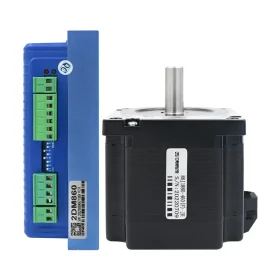
• Matched products 57J1856‑440 (1.2 N·m, frame 57) or 86J1880‑460 (4.5 N·m, frame 86) + 2DM556 (1.4–5.6 A, DC 24–60 V) or 2DM860 (2.1–8.4 A, DC 24–110 V) • Applicable equipment PV light conveyors (load ≤10 kg), small Li‑ion auxiliary transfer fixtures, simple positioning/stop equipment, low‑speed light auxiliary winding (roll dia. ≤200 mm, line speed ≤10 m/min) • Technical features Smooth at medium‑low speeds; resonance speeds (typically 120–240 rpm) require vibration suppression; Gentle start/stop for intermittent low‑speed operation; Strict limitation: only for simple auxiliary stations with small roll diameter change (<10%) and no high‑precision tension control; prohibited for main winding/unwinding or cutting stations; IP54 optional for dusty environments. • Selection boundary Tension fluctuation >±10% is unacceptable; upgrade to Solution 5 (servo) if line speed >15 m/min or roll dia. >200 mm.
PV & Lithium‑Battery New Energy-solution-1

Solution 2: Mid‑range quality improvement – Closed‑loop stepper for low‑speed continuous operation

• Matched products 86J1880EC‑1000‑LS (4.5 N·m, 1000 P/R) or 86J18118EC‑1000‑LS (8.5 N·m) + 2HSS86H (0–6 A, DC 30–100 V / AC 24–75 V) • Applicable equipment Medium material conveyors, standard low‑speed slitting auxiliary (auxiliary pull, not main blade), small/medium light winding/unwinding (roll dia. <300 mm, line speed ≤20 m/min), Li‑ion sorting equipment positioning axes • Technical features 1000‑line encoder real‑time closed‑loop error correction eliminates accumulated low‑speed drift (repeatability ±0.02 mm); Low heat (rise ≤30 °C), better fatigue resistance than open‑loop; Insufficient constant‑torque performance (tension fluctuation >±10%) – cannot meet high‑speed (>30 m/min) or large‑roll (>300 mm) constant‑tension needs; Noise ≤42 dB. • Selection boundary Only for auxiliary processes (not main winding/unwinding/cutting), line speed ≤20 m/min; core constant‑tension applications must use Solution 5 (servo).
PV & Lithium‑Battery New Energy-solution-2

Solution 3: Integrated closed‑loop stepper – Compact installation for auxiliary stations

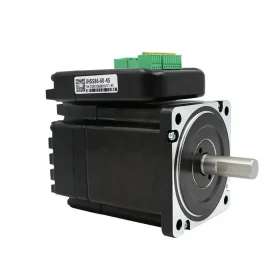
• Matched products IHSS86‑60‑45 (4.5 N·m, 60 V, 1000 P/R) or IHSS86‑80‑85 (8.5 N·m, 80 V) • Applicable equipment PV light conveyor drives, Li‑ion sorting positioning axes, auxiliary winding pull rolls (roll dia. ≤200 mm) • Technical features Drive integrated into motor, saving cabinet space (axial length shortened ~35 mm); 1000 P/R encoder closed‑loop, repeatability ±0.025 mm; Optional brake (holding torque ≥2× rated) for vertical auxiliary stations; Torque range 4.5–12 N·m, but dynamic response and constant‑torque performance remain at stepper level – not for main winding/unwinding; IP54/IP65 optional (IHSS standard IP40, IRSS series IP65). • Selection boundary Suited for compact auxiliary stations without high‑speed tension demands; main winding/unwinding must use Solution 5 (high‑voltage servo).
PV & Lithium‑Battery New Energy-solution-3

Solution 4: Bus integrated closed‑loop stepper – Distributed auxiliary control

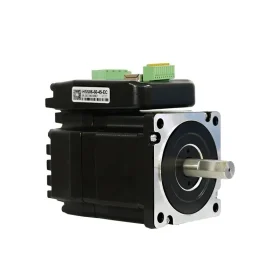
• Matched products IHSS86‑60‑45‑EC (4.5 N·m, EtherCAT) or IHSS86‑80‑85‑EC (8.5 N·m, EtherCAT) • Applicable equipment Smart conveyor auxiliary drives, distributed positioning stations, multi‑station sorting auxiliary axes • Technical features EtherCAT distributed control, minimal wiring, sync <1 μs; Digital I/O (3 in / 2 out) for independent logic; Only for distributed auxiliary stations, not for main tension‑controlled axes; IP54/IP65 optional. • Selection boundary Suitable for auxiliary distributed control with wiring constraints; main winding/unwinding constant‑tension core processes must upgrade to Solution 5 or 6 (servo).
PV & Lithium‑Battery New Energy-solution-4

Solution 5: Heavy‑duty constant‑tension high‑voltage servo – Core high‑speed mass‑production process

• Matched products For web width ≤600 mm: 130JASM508215K (850 W, rated 5.41 N·m, peak 16.23 N·m) or 130JASM515220K (1500 W, rated 7.2 N·m, peak 24.6 N·m, 17‑bit encoder) For web width >600 mm or heavy load (roll dia. >500 mm): 180JASM530315K (3000 W, rated 18.5 N·m, peak 46 N·m, 23‑bit encoder) Drives: JAND15002‑23B‑EC (1500 W) or JAND30002‑23B‑EC (3000 W, EtherCAT) + JMC‑101‑16 (EtherCAT controller) • Applicable equipment Li‑ion high‑speed slitting machines (main winding/unwinding), electrode coating equipment (traction/main winding), PV automatic cutting equipment (feed/cutting main drive), new energy multi‑axis mass‑production lines • Technical features High‑accuracy speed and torque closed‑loop control with tension sensor + PID for stable constant tension (fluctuation <±3%), preventing wrinkles/stretching; 17‑bit/23‑bit encoder for positioning accuracy ±0.01 mm; Bus multi‑axis sync accuracy <1 μs, drift <0.03 mm over 24 h; EMC optimised (Level 3), noise ≤45 dB; Selection constraint : For web width >600 mm or line speed >60 m/min or roll dia. >500 mm, must use 180 frame (≥15 N·m) with at least 1.5× torque margin; IP54/IP65 optional on motor body. • Selection boundary All core mass‑production processes (main winding/unwinding, traction, cutting) must use this solution or higher.
PV & Lithium‑Battery New Energy-solution-5

Solution 6: Bus integrated low‑voltage servo – Distributed constant‑tension auxiliary control

• Matched products IHSV86‑30‑44‑48‑EC (48 V, 440 W, rated 1.4 N·m, 1000 P/R, EtherCAT) or IHSV86‑30‑66‑72‑EC (72 V, 660 W, rated 2.1 N·m) • Applicable equipment Multi‑axis distributed tension control auxiliary stations (not main winding), auxiliary pull axes (load ≤5 kg), compact winding/unwinding units (roll dia. ≤200 mm) • Technical features Fully integrated drive, control, communication, EtherCAT distributed control; Compact for distributed mounting; 17‑bit / 1000 P/R encoder for tension‑closed‑loop accuracy; Power range 52 W–660 W, only for auxiliary tension control and distributed pulling (not main winding); IP65/IP67 optional. • Selection boundary Suitable for auxiliary pulling and distributed auxiliary stations; main winding/unwinding core processes must use Solution 5 (high‑voltage servo).
PV & Lithium‑Battery New Energy-solution-6

Technical Advantages

Full‑process application coverage

From auxiliary conveying (open‑loop stepper), mid‑range low‑speed (closed‑loop/integrated stepper), to high‑end high‑speed mass production (servo/integrated servo), optimally balancing cost and stability.

Servo‑exclusive constant‑tension stable‑speed mass production

Servo torque closed‑loop provides stable output (tension fluctuation ±10%).

High durability continuous operation

Servo optimised heat rise (<30 °C) and fatigue‑resistant algorithms, extremely low drift (<0.03 mm/24 h) under 24‑h heavy load, ensuring high OEE.

Low interference for precision processes

Servo EMC design (Level 3) reduces equipment interference, suitable for new energy precision inspection and sorting.

Industry Application Cases

Auxiliary conveying – Stepper for new energy light auxiliary equipment

For light‑duty low‑speed auxiliary tasks, open‑loop steppers are smooth and reliable, only for non‑precision tension stations, cost‑effective for line auxiliary support.

Process upgrade – Closed‑loop/integrated stepper for mid‑range new energy low‑speed equipment

Addresses long‑term positional drift in low‑speed conveying/slitting auxiliary with real‑time compensation, improving semi‑finished product regularity; high‑speed tension capability limited – only for auxiliary processes.

Distributed auxiliary – Bus integrated stepper for smart conveyor lines

For multi‑station distributed auxiliary drives, integrated bus stepper combines drive and communication, minimising wiring and system cost.

High‑speed mass production – Servo for new energy high‑speed cutting equipment

For core high‑speed cutting in PV/Li‑ion, servos deliver constant torque and uniform speed, precise cutting dimensions and smooth edges – the mainstream solution for web constant‑tension control.

Line integration – Bus servo for fully automatic new energy mass‑production lines

For high‑end automated lines, EtherCAT multi‑axis synchronisation ensures smooth coordination across coating, slitting, conveying, and winding with extremely low drift over 24‑h continuous production.

Ouote Request

Get a personalized quote tailored to your needs with our
quick and easy Quote Request Form.