Motion Control Solutions for Packaging, Textile & Printing

Stable Speed, Constant Tension, Precision Registration — Solutions for Continuous Automated Mass Production in Light Industry

Packaging, Textile & Printing

Industry technical challenges

Unstable web tension causing wrinkling, stretching, and deformation

Printing films, textile fabrics, and packaging webs require continuous uniform-speed feeding. Stepper motor torque fluctuates significantly with speed, limiting it to low-speed light-load simple winding without high-speed constant tension control capability. Conventional drives with speed fluctuations and uneven torque output cause uneven web tension, stretching, wrinkling, misalignment, and irregular winding, directly resulting in printing registration errors, textile defects, and packaging appearance flaws.

High-speed cutting and color-registration alignment deviation, poor batch consistency

Label printing, die-cutting, fabric cutting, and packaging die-cutting equipment require high-speed dynamic color registration and fixed-length cutting. High-speed dynamic color registration demands extremely fast response and high starting frequency — stepper motors cannot meet these requirements and are limited to low-speed point-to-point cutting. Conventional drives with response lag and insufficient repeat positioning accuracy cause cutting length deviation, registration misalignment, and pattern shifting, resulting in poor product standardization.

Multi-axis cycle asynchronization causing line stuttering and disorder

Fully automatic packaging lines, textile printing/dyeing lines, and rotary printing presses involve multiple processes: feeding, printing, cutting, winding, and stacking. Multi-axis coordination timing is extremely demanding. Conventional control systems with weak synchronization accuracy and cycle disorder cause inter-process stuttering, material jamming, and idle runs — limiting overall line productivity.

High failure rate in long-duration continuous operation, significant downtime losses

Light-industry equipment typically runs 24/7 with high-frequency start-stop cycles and continuous uniform-speed operation. Conventional drives suffer from heat accumulation and poor fatigue resistance, leading to step loss, positional drift, and breakdowns. Frequent downtime for commissioning causes web material waste and production capacity loss.

Working Condition

Stepper Motor System Applications

Suited for medium‑low speed intermittent operation, point‑to‑point cutting, simple feeding, and light auxiliary stations in packaging, textile & printing, including:
Open‑loop stepper: For small sealing, labelling, and low‑speed feeding auxiliary with no constant‑tension requirement.
Closed‑loop stepper: For medium‑low speed fixed‑length cutting and feeding equipment where accumulated positional deviation must be eliminated.
Critical limitation: Stepper systems cannot handle high‑speed dynamic colour registration or high‑speed constant‑tension winding core processes.
Right column – Servo motor system applications

Servo Motor System Applications

Suited for high‑speed continuous rotary motion, dynamic colour registration, constant‑tension winding/unwinding, and multi‑axis synchronised mass production in packaging, textile & printing, including:
High‑voltage servo (220V): For high‑speed rotary presses, fully automatic multi‑colour registration equipment, precision die‑cutters, textile setting winders, and high‑speed pillow packaging lines.
Integrated servo: For compact packaging units and distributed tension control stations.
Technical features: With tension feedback and controller synchronisation algorithms, ensuring smooth mass production, neat finished products, and controllable deviation – the mainstream solution for high‑speed colour registration and constant‑tension control.

Tiered Technical Solutions

Industry characteristics & selection logic:

Packaging, textile & printing are defined by high‑speed continuous operation (>100 m/min), registration accuracy (<0.1 mm), dynamic colour‑registration response (<50 ms), and constant‑tension control (fluctuation <±5%). Core processes (printing, registration, die‑cutting, winding) require high‑response servos; steppers are limited to peripheral low‑speed auxiliary stations. Food packaging/textile dyeing environments involve moisture and ink splashes – IP54/IP65 is recommended.

Solution 1: General‑purpose economical open‑loop stepper – Low‑speed auxiliary stations

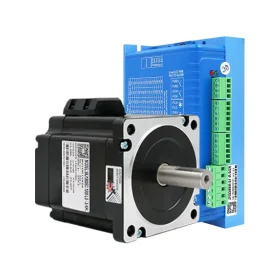
• Matched products 57J1841‑420 (0.75 N·m) or 57J1856‑440 (1.2 N·m) + 2DM542 (1.0–4.2 A, DC 24–48 V) or 2DM556 (1.4–5.6 A, DC 24–60 V) • Applicable equipment Small labelers (low speed ≤30/min), simple sealing/packaging machines, light fabric low‑speed cutting machines, basic web low‑speed feeding auxiliary (line speed ≤10 m/min) • Technical features Smooth at medium‑low speeds; resonance points (120–200 rpm) need vibration suppression; Low start‑stop impact for intermittent low‑speed point operations; Strict limitation: only for simple auxiliary stations without constant‑tension; prohibited for high‑speed colour registration (>50 m/min) and high‑speed tension control (>30 m/min); IP54 optional (moisture/ink environments). • Selection boundary Line speed ≤15 m/min, no‑tension auxiliary stations; for high‑speed colour registration or main constant‑tension winding, upgrade to Solution 5 (servo).
packaging-textile-printing-solution-1

Solution 2: Mid‑range closed‑loop stepper upgrade – Low‑speed fixed‑length cutting/feeding quality improvement

• Matched products 86J1880EC‑1000‑LS (4.5 N·m) or 86J18118EC‑1000‑LS (8.5 N·m, 1000 P/R) + 2HSS86H (0–6 A, DC 30–100 V) • Applicable equipment Mid‑range automatic low‑speed die‑cutters (≤30 cuts/min), standard registration auxiliary equipment, medium textile low‑speed printing/dyeing equipment, standard light winding/unwinding packaging (roll dia. ≤300 mm) • Technical features Real‑time closed‑loop error correction eliminates accumulated step loss in long‑term low‑speed operation, fixed‑length cutting repeatability ±0.02 mm; Low heat (rise ≤30 °C), better fatigue resistance; High‑speed dynamic response (torque drop >30% above 600 rpm) and constant‑torque performance insufficient for high‑speed registration (>60 m/min) or high‑speed web tension control; IP54 optional. • Selection boundary Line speed ≤25 m/min, fixed‑length cutting/feeding auxiliary; for high‑speed rotary printing or die‑cutting, use Solution 5 (servo).
packaging-textile-printing-solution-2

Solution 3: Integrated closed‑loop stepper – Compact packaging auxiliary drive

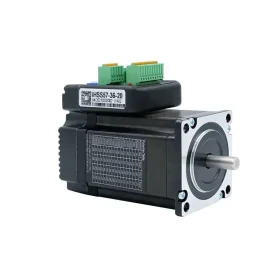
• Matched products IHSS57‑36‑20 (2.0 N·m) or IHSS60‑36‑30 (3.0 N·m, 1000 P/R encoder) • Applicable equipment Small packaging machine feed axes, labeler pull rollers, auxiliary winding pull units (roll dia. ≤200 mm) • Technical features Drive integrated, axial length shortened ~30 mm; 1000 P/R encoder closed‑loop, repeatability ±0.025 mm; No high‑speed registration capability (response >100 ms) – only for low‑speed auxiliary pulling; IP54/IP65 optional (IRSS series). • Selection boundary Suited for compact low‑speed auxiliary pulling; main high‑speed packaging drive – use Solution 5 or 6 (servo).
packaging-textile-printing-solution-3

Solution 4: Bus integrated closed‑loop stepper – Distributed packaging auxiliary control

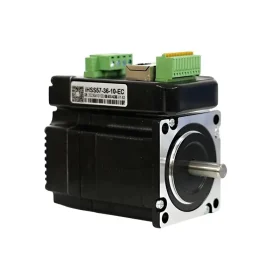
• Matched products IHSS57‑36‑20‑EC (2.0 N·m, EtherCAT) or IHSS60‑36‑30‑EC (3.0 N·m) • Applicable equipment Smart packaging line distributed feeding units, multi‑station labelling auxiliary axes, flexible conveyor positioning modules • Technical features EtherCAT distributed control, minimal wiring, sync <1 μs; Digital I/O (3 in/2 out) for simple logic; Only for auxiliary distributed control, not for main printing/die‑cutting axes. • Selection boundary Suitable for distributed auxiliary stations; for main high‑speed drives, use Solution 5 or 6.
packaging-textile-printing-solution-4

Solution 5: High‑speed colour‑registration constant‑tension high‑voltage servo – Core mass‑production processes

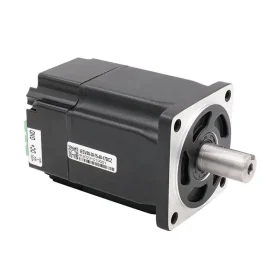
• Matched products 80JASM507230K (750 W, rated 2.39 N·m, peak 7.1 N·m, 17‑bit) for small/medium printing traction (web width ≤600 mm) 130JASM515220K (1500 W, rated 7.2 N·m, peak 24.6 N·m) for large rotary printing/heavy winding (web width >600 mm) Drives: JAND7502‑23B‑EC / JAND15002‑23B‑EC (EtherCAT) + JMC‑101‑16 (EtherCAT controller) • Applicable equipment High‑speed rotary presses (plate cylinders/pull rolls), fully automatic multi‑colour registration equipment, high‑speed die‑cutting lines, textile setting winding mass‑production equipment, fully automatic vertical/pillow packaging lines • Technical features High‑accuracy speed and torque closed‑loop with tension sensor + PID for constant‑tension stable conveying (fluctuation <±3%); Bus multi‑axis high‑speed synchronisation (jitter <1 μs), dynamic colour‑registration response <50 ms, cutting accuracy ±0.05 mm; 24‑h continuous drift <0.02 mm, noise ≤45 dB; Selection constraint: For web width >600 mm or line speed >120 m/min or winding tension >50 N, use 130 frame (≥7 N·m) or higher; IP54/IP65 optional (mandatory in moisture/ink environments). • Selection boundary All core processes (high‑speed printing, registration, die‑cutting, main winding) must use this solution or higher.
packaging-textile-printing-solution-5

Solution 6: Bus integrated low‑voltage servo – Distributed tension & packaging control

• Matched products IESV80‑30‑75‑48‑EC (48 V, 750 W, rated 2.38 N·m, 17‑bit, EtherCAT) or IHSV86‑30‑44‑48‑EC (48 V, 440 W, rated 1.4 N·m) • Applicable equipment Distributed tension control units (auxiliary pulling, not main winding), compact packaging equipment drive axes, multi‑station registration auxiliary axes • Technical features Fully integrated drive, control, communication, EtherCAT distributed control; 17‑bit encoder ensures tension‑closed‑loop and positioning accuracy (repeatability ±0.02 mm); Power limit 750 W (2.38 N·m) – only for auxiliary pulling and distributed auxiliary, not for main winding/unwinding; IP65/IP67 optional (IRSV series). • Selection boundary Suitable for distributed auxiliary tension control and compact packaging; main printing/main winding – upgrade to Solution 5 (high‑voltage servo).
packaging-textile-printing-solution-6

Technical Advantages

Full‑scene light‑industry tiered adaptation

Six‑tier solutions cover simple low‑speed (open‑loop stepper), mid‑range low‑speed (closed‑loop/integrated stepper), and high‑end high‑speed lines (servo/integrated servo), precisely matching cost and performance.

Servo‑exclusive constant‑tension stable web control

Servo torque output is continuously stable (fluctuation ±10%).

Servo high‑speed registration and cutting accuracy

Fast dynamic response + high‑precision synchronisation (<1 μs) ensures stability in high‑speed registration, cutting, and dynamic colour tracking, with high batch consistency (±0.05 mm).

Long‑term mass‑production durability

Optimised heat rise and fatigue‑resistant algorithms (servo rise <30 °C) result in low failure rate, reduced downtime and material waste, and improved OEE.

Industry Application Cases

Basic light‑industry – Open‑loop stepper for small low‑speed packaging equipment

For light‑industry low‑speed intermittent operation, open‑loop steppers are smooth and reliable; not for high‑speed registration or tension control – cost‑effective.

Process quality improvement – Closed‑loop/integrated stepper for mid‑range low‑speed printing/cutting

Addresses long‑term drift in low‑speed die‑cutting and auxiliary registration with real‑time compensation, providing accurate fixed‑length cutting at low speed; high‑speed performance limited.

Distributed auxiliary – Bus integrated stepper for smart packaging lines

For multi‑station distributed auxiliary drives, integrated bus stepper combines drive and communication, minimising wiring and system cost.

High‑speed mass production – Servo for high‑speed rotary printing/packaging equipment

For high‑end high‑speed rotary and die‑cutting core processes, servo with tension and position closed‑loop ensures stable web tension and accurate high‑speed registration/cutting, greatly improving efficiency.

Line integration – Bus servo for fully automatic high‑speed light‑industry mass‑production lines

For fully automatic multi‑process high‑speed lines, EtherCAT ensures highly synchronised multi‑axis timing, seamless feeding, printing, cutting, and winding – stable and efficient long‑term mass production.

Ouote Request

Get a personalized quote tailored to your needs with our
quick and easy Quote Request Form.